The problem
Notation, jargon and caveats stand between you and the idea. You read the abstract twice and still are not sure what the paper claims, or where that claim stops.
Launching soon
TimeZyme turns a research paper into three reading depths for researchers, students and curious readers. Start with the big idea, follow the argument, then check each claim against its source.
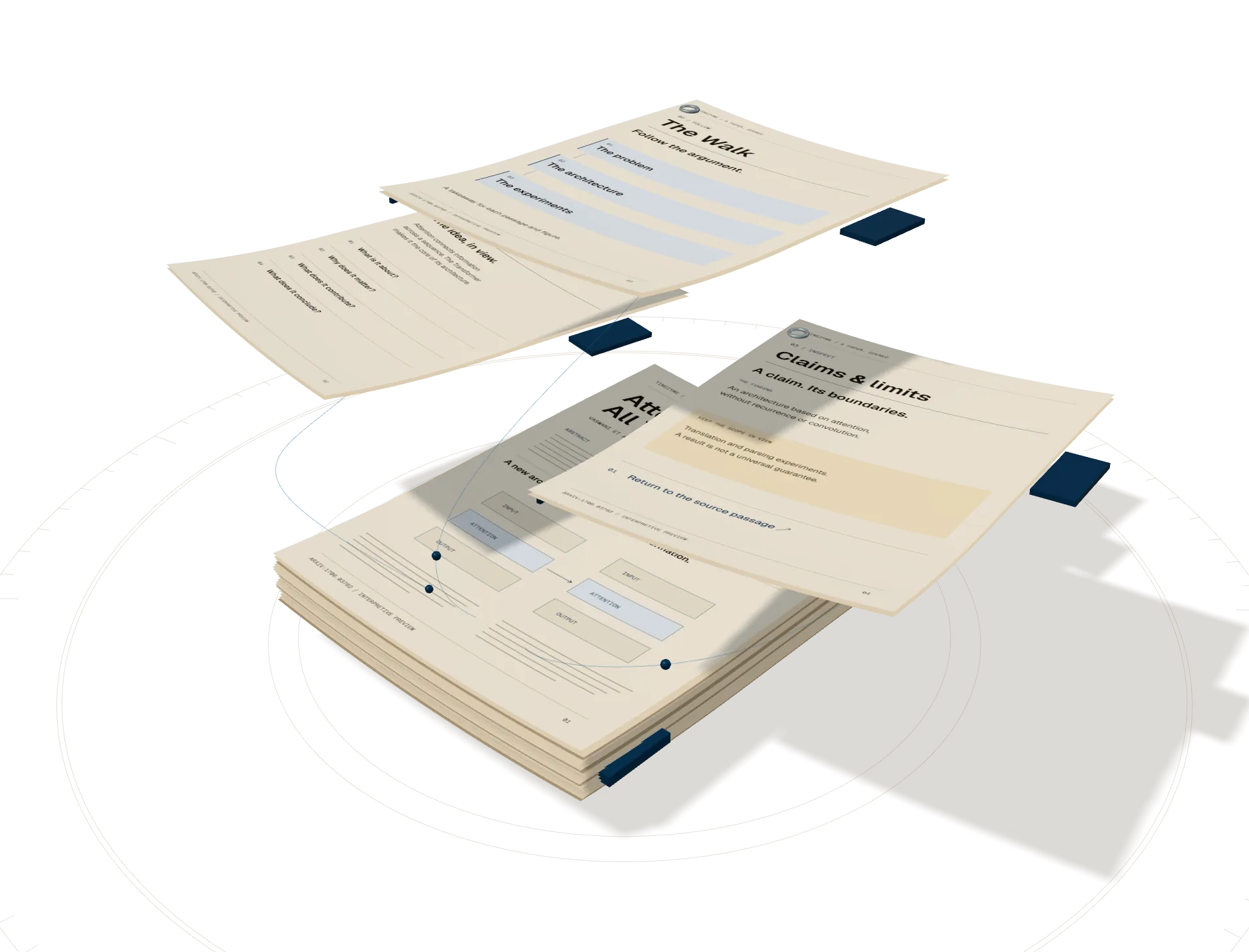
Snapshot the central idea. Walk through the reasoning. Inspect claims, limits and source passages.
Read the example below01Why papers feel hard
The architecture performs sequence transduction without recurrence or convolution, stacking parallel attention heads with sinusoidal positional encodings to model dependencies across the whole input.
For all ages Instead of carrying information through a chain, the Transformer uses attention to connect the parts that matter.
Notation, jargon and caveats stand between you and the idea. You read the abstract twice and still are not sure what the paper claims, or where that claim stops.
TimeZyme lays out the same paper in three reading depths. Every answer links back to the passage it came from, and quotes are never reworded.
02What you get
The Snapshot gives you a TL;DR, four guiding answers and the key terms defined, each tied to the passages behind it.
The Walk follows the authors’ order through paragraphs, figures, tables and formulas, with a plain language takeaway along the way.
Claims & limits lists the authors’ claims in source order, with their qualifications in their own words.
Academic keeps the mathematical notation. For all ages explains the math in words without rewriting quotes.
03How it works
Add a paper by its arXiv link or ID. TimeZyme prepares all three reading depths from the original.
Start with the Snapshot, follow The Walk, or open Claims & limits when a conclusion needs a closer read.
Select a citation number to open the exact passage, highlighted in the text around it.
04Don't take our word for it. Take a sentence.
A real paper, read three ways. Switch depth, change edition, then open the source behind the answer.
The Transformer uses attention to connect information across a sequence, replacing recurrence and convolution in its architecture.
Original paper / abstract
“We propose a new simple network architecture, the Transformer, based solely on attention mechanisms, dispensing with recurrence and convolutions entirely.”Read this in the original abstract
A source link shows where a statement comes from. It does not independently establish that the statement is true. This compact demo is authored for this page, not generated by a live processing run.
05FAQ
TimeZyme turns a dense research paper into three reading depths. The Snapshot gives you the big idea, The Walk follows the argument in the authors’ order, and Claims & limits shows what the paper claims and where those claims stop.
Academic papers on arXiv. You add one by its arXiv link or ID. Uploads from your device and other sources are not supported yet.
No. Every depth keeps the original within reach, and quotes are never reworded. TimeZyme helps you find your footing so your close reading goes further.
Select a citation number to open the passage it cites, highlighted in the surrounding text. A source link shows where a statement comes from. It does not prove that the statement is true.
Academic keeps the mathematical notation. For all ages explains the math in words without rewriting quotes. Both editions stay tied to the same paper and the same evidence.
No. TimeZyme does not use submitted documents to train AI models.
TimeZyme is launching soon. Until then, the preview on this page reads a real paper three ways, and you need no account to try it.
No. It is written for this page from a real paper, Attention Is All You Need (2017). It is not generated by a live processing run.
For researchers, students and curious readers
Spend less time finding your footing and more time deciding what the paper means for your work.